In this article
- 1.Why Fitness App Motivation Is Not Just About Willpower
- 2.Key Stats / Useful Data Points
- 3.What Fitness Apps Get Right
- 4.Did You Know? Self-Monitoring Is One of the Core Behaviour Tools
- 5.Why Fitness Apps Still Fail
- 6.Where Motivation Turns Into Pressure
- 7.Evidence Snapshot: Apps Can Help, but Retention Is the Real Test
- 8.What Good Fitness App Design Should Do
- 9.How AI Can Help Without Becoming the Authority
- 10.Myth vs Reality: More Motivation Features Are Not Always Better
- 11.Where Emorya Fits
- 12.How Rewards Should Support Motivation
- 13.Common Mistakes Fitness Apps Make
- 14.Try This Today: Audit Your App by the Return Test
- 15.Related Next Steps
- 16.Useful Sources
- 17.FAQs
- 18.Conclusion
Key takeaway
Fitness apps are most useful when they turn healthy actions into clear feedback: steps, active minutes, calorie intake, food scans, progress, reminders, and rewards
They fail when the experience becomes noisy, judgemental, too technical, or built around pressure instead of repeatable behaviour.
Core topic
Fitness apps work when they make progress visible, reduce friction, and help people return. They fail when they overload users, create pressure, or make the metric louder than the habit.
Reader-first
The article is designed to answer the question clearly before adding product context.
No hype
Claims stay grounded in everyday behaviour, not exaggerated transformation promises.
Actionable follow-on
Related reads help connect the idea to a wider routine.
Related next steps
Useful follow-ons if you want to turn the idea into action.
Why Fitness App Motivation Is Not Just About Willpower
Most people do not open a fitness app because they need another lecture about discipline.
They open it because they want a clearer signal. Did I move enough today? Am I getting fitter? Did that walk count? Is my food pattern helping or holding me back? Am I still making progress if this week was messy?
That is where fitness apps can be genuinely useful.
The best fitness apps do not create motivation from nowhere. They make the user's own effort easier to notice.
That distinction matters. Motivation is not a permanent mood. It rises, drops, disappears, returns, gets interrupted by life, and often needs a smaller next step rather than a bigger speech. A good health app should respect that.
For Emorya, this is the app-first opportunity: make movement, calorie awareness, progress, and rewards visible without making wellness feel like homework.
Key Stats / Useful Data Points
- A British Journal of Sports Medicine systematic review and meta-analysis found that smartphone apps and activity trackers can increase physical activity in adults, while noting that engagement and retention need better study.
- A systematic review of mHealth gamification interventions describes common app features such as points, leaderboards, progress bars, badges, goals, and feedback, while also noting that evidence quality and intervention design vary.
- A 2024 systematic review and meta-analysis of digital health apps with and without gamification reported physical-activity and cardiometabolic findings from randomized trials, but the practical takeaway is still cautious: design quality matters.
- The WHO's 2024 AI health governance guidance highlights potential health uses of AI while warning about false, inaccurate, biased, or incomplete outputs.
What Fitness Apps Get Right
Fitness apps get motivation right when they reduce the distance between action and feedback.
Without an app, a healthy action can feel invisible. You walk more, but the day still feels ordinary. You choose a better lunch, but nothing obvious changes. You stretch, sleep better, or return after missing a workout, but the effort disappears into the background.
An app can make that effort visible.
Fitness apps are useful when they turn vague intention into visible progress.
That can happen through steps, active minutes, calorie intake, calories burned, body progress, food scans, streaks, milestones, weekly trends, reminders, social support, or rewards. The feature is less important than the job it does.
A step count answers, "Did I move today?" Active minutes answer, "Did I include enough effort?" A food scan answers, "What did this meal add to the day?" A progress chart answers, "Is the pattern changing?" A reward answers, "Did the system recognise the action?"
That is the strength of digital wellness. It can make quiet effort less invisible.
Did You Know?
Self-Monitoring Is One of the Core Behaviour Tools
Many fitness app features are not random decorations. They map onto known behaviour-change ideas such as self-monitoring, feedback, goal setting, prompts, rewards, and social support.
The npj Digital Medicine review of social features in mHealth notes that interventions often use social support or comparison, and that user preferences are mixed. Some people respond well to support and competition. Others dislike comparison or worry about privacy.
The useful lesson is not that every app needs more features. It is that the right feedback depends on the user.
That is why personal progress can be more motivating than public ranking for many people. A leaderboard might energise one user and quietly discourage another.
Why Fitness Apps Still Fail
Fitness apps often fail for a surprisingly human reason: they ask for too much before the habit is stable.
The user starts with good intent. Then the app asks for precise meals, perfect workouts, complete profiles, manual entries, wearable permissions, daily check-ins, multiple goals, notifications, streaks, charts, badges, social sharing, and a level of attention that normal life does not always have available.
At first, it feels exciting. Then it feels like admin.
A fitness app fails when the effort required to use the app becomes heavier than the habit it is meant to support.
This is especially true for beginners. Someone who is trying to walk more does not need a dashboard that makes them feel late to a race they never joined. Someone learning calorie awareness does not need every meal to become a moral exam. Someone returning after a low week does not need a red warning light that says the routine is broken.
The app should lower friction. If it raises friction, people drift.
Where Motivation Turns Into Pressure
The line between useful feedback and pressure is thinner than many products admit.
A reminder can help. Too many reminders become noise. A streak can encourage return. A brittle streak can make one missed day feel like failure. A goal can give structure. An unrealistic goal can make the user feel behind before they begin.
Motivation becomes pressure when the app treats imperfect behaviour as a character flaw instead of normal human data.
Good design gives people a way back. It notices the missed day without turning it into a collapse. It helps someone restart with a smaller action, not a heavier sense of guilt.
That is one reason Emorya's wider positioning matters. Rewards should support consistency, not replace the reason health matters. Progress signals should encourage return, not punish ordinary imperfection.
For the deeper incentive layer, read Rewards Are Not the Goal.
Evidence Snapshot
Apps Can Help, but Retention Is the Real Test
Research on fitness apps and trackers generally supports a careful middle position.
Mobile apps, activity trackers, gamification, feedback, goals, and social features can support physical activity for some users. But evidence is mixed across designs, populations, features, and follow-up periods. Retention is a recurring issue, and it is often difficult to isolate which feature caused the behaviour change.
The evidence does not say fitness apps magically motivate everyone. It suggests they can support behaviour when the design fits the user's real life.
That is the product lesson. A good app is not the one with the most features. It is the one that helps someone repeat the next useful action.
What Good Fitness App Design Should Do
A good fitness app should make the next action clearer.
That sounds simple because it is. It is also where many apps lose focus.
If the user wants to walk more, the app should help them see a realistic baseline, improve it gradually, and notice everyday wins. If the user wants better calorie awareness, the app should make food logging easier and safer, not more obsessive. If the user wants rewards, the app should make incentives feel like support, not income or pressure.
The best fitness app motivation is practical: one clear signal, one realistic next step, and one reason to come back.
That might mean:
- steps for daily movement
- active minutes for weekly effort
- calorie intake for food awareness
- food scans for lower-friction logging
- milestones for progress
- rewards for consistency support
- a forgiving reset after missed days
If the system does those things calmly, the user gets something useful: not a perfect body, not guaranteed results, not a magic health outcome, but a clearer routine.
For movement tracking, read Active Minutes vs Steps: Which Should You Track First?. For the gamification layer, read How Gamification Helps People Stay Consistent.
How AI Can Help Without Becoming the Authority
AI is becoming part of mainstream health apps because it can reduce friction.
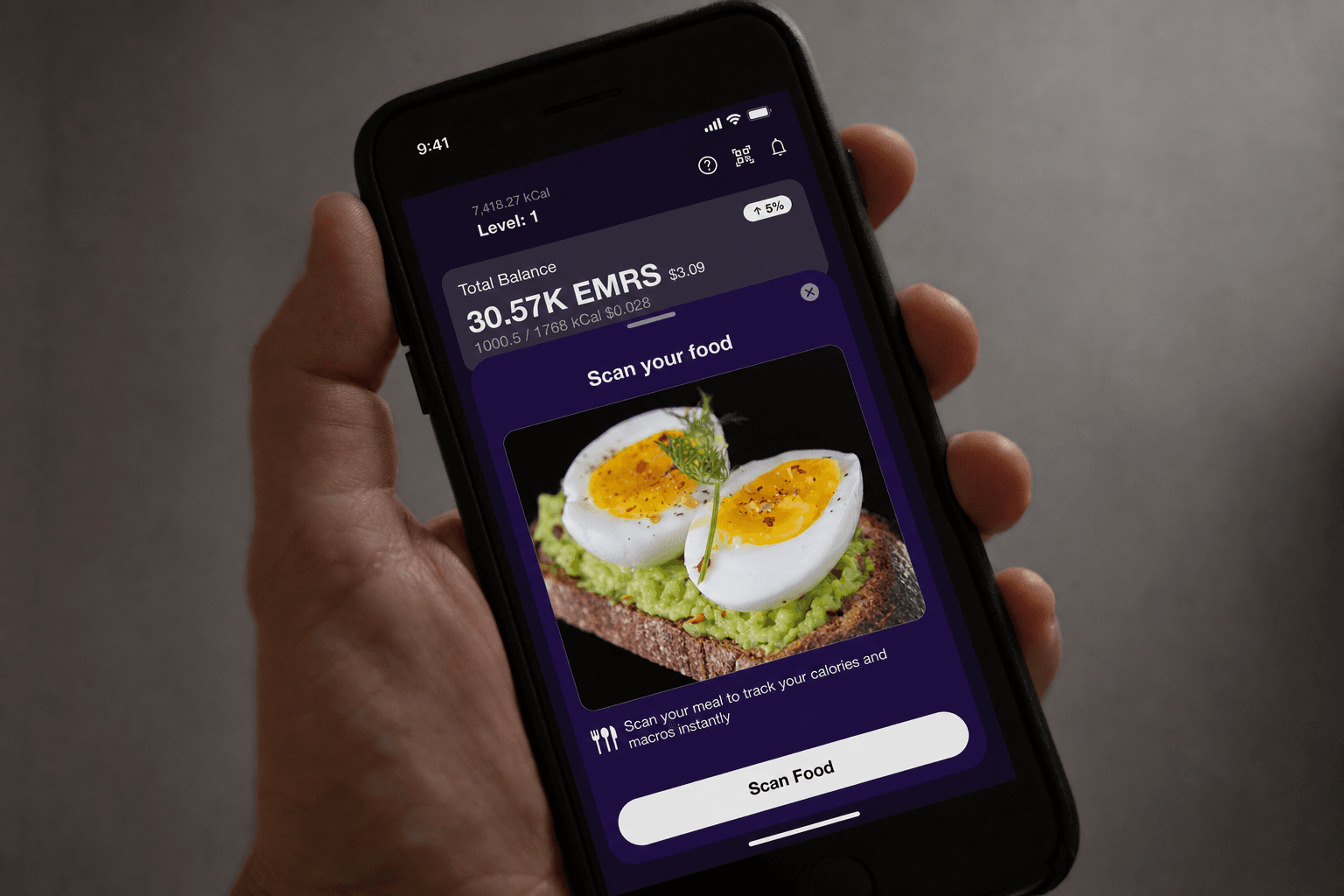
That is especially true for food tracking. Manual calorie logging asks users to search, estimate, select, edit, and repeat. AI food scanning can make the first step easier by turning a photo into an initial estimate that the user can review.
AI food scanning is most useful when it improves awareness, not when it pretends to be perfect.
That framing is important. The WHO's AI health guidance highlights both possible benefits and risks, including inaccurate or incomplete outputs. In a wellness app, that means AI should support the user's judgement rather than replace it.
For Emorya, the value is the bigger loop: food intake, calories burned, movement, body progress, and consistency in one place. The AI food scanner can reduce friction. The calorie management system can make patterns clearer. But the user still needs calm, reviewable feedback.
For the full nutrition angle, read AI Food Scanning and Calorie Deficit. For the pressure-aware version, read The Calm Side of Calorie Awareness.
Myth vs Reality
More Motivation Features Are Not Always Better
The myth is that a fitness app becomes more motivating every time it adds another goal, badge, chart, reminder, challenge, or reward.
The reality is sharper.
Motivation features only work when they reduce friction or make progress clearer.
If a feature adds noise, comparison, guilt, or confusion, it may weaken the habit. A quiet weekly trend can be more useful than a dramatic daily alert. A forgiving streak can be better than a perfect streak. A small milestone can be better than a public leaderboard.
The right question is not, "Can we add more motivation?" It is, "What kind of feedback helps this user return?"
Where Emorya Fits
Emorya sits in the space between health tracking and reward-supported consistency.
That is a useful position if it stays disciplined.
The app can show movement. It can help users understand calories. It can connect food intake with calories burned. It can make progress visible. It can support motivation with milestones and rewards. It can bring wallet/token features into the experience gradually, only when relevant, without making beginners understand crypto before they understand their own routine.
Emorya's strongest fitness-app role is to make everyday health behaviour visible without making the user feel managed by the app.
That is why the product should remain health-first. Rewards sit underneath the behaviour. AI supports awareness. Calorie management gives context. Movement tracking gives a daily signal. The user should feel guided, not controlled.
This is the same principle behind how Emorya turns movement into digital value: the value begins with the behaviour, not with hype around the reward layer.
How Rewards Should Support Motivation
Rewards can be useful, but they are delicate.
If a reward makes a healthy action feel recognised, it can support consistency. If it makes the user feel like movement is only worth doing for the payout, the design has lost the plot.
Rewards should make healthy actions easier to repeat, not turn health into an income promise.
That is especially important for any wellness app with Web3 depth. Beginners should not feel that they need token knowledge, wallet confidence, or financial expectations to start moving, scanning food, or building a routine.
In Emorya, EMRS should be understood first as an in-app reward/progress layer. EMR and wallet features belong deeper in the ecosystem, explained only when useful. The first user experience should still make sense without crypto language.
Common Mistakes Fitness Apps Make
The first mistake is making onboarding too heavy. A user should not need to complete a data form longer than their first workout.
The second mistake is treating every metric as equally important. Steps, active minutes, calories, food scans, sleep, weight, streaks, rewards, and heart-rate zones can all be useful, but not all at once.
The third mistake is designing streaks with no mercy. Real routines include travel, illness, stress, family, work, low-energy days, and rest. A fitness app should help the user return, not make them feel as if one missed day erased everything.
The fourth mistake is overpromising. Apps can support healthy behaviour. They should not guarantee weight loss, fitness transformation, income, medical outcomes, or perfect AI accuracy.
The app should be a support system, not another source of pressure.
Try This Today
Audit Your App by the Return Test
Open the fitness or wellness app you use most and ask one simple question: does this make me more likely to return tomorrow?
Look at three things:
- Does the app show one clear next action?
- Does the feedback make progress feel visible?
- Does the app help after a missed day, or does it make the miss feel bigger?
A good fitness app should make the next healthy action easier, not make the user feel behind.
If the answer is unclear, simplify your tracking for a week. Pick one daily signal, such as steps, and one weekly signal, such as active minutes. Let everything else become background until the habit feels stable.
Related Next Steps
If you want the behaviour-design layer, read How Gamification Helps People Stay Consistent.
If you want the AI calorie layer, read AI Food Scanning and Calorie Deficit.
If you want the rewards-safety layer, read Rewards Are Not the Goal.
If you want the simplest movement-tracking layer, read Active Minutes vs Steps.
If you want the calorie-awareness angle without pressure, read The Calm Side of Calorie Awareness.
Useful Sources
- British Journal of Sports Medicine: Smartphone apps, activity trackers, and physical activity
- JMIR / PMC: Effects of mHealth-based gamification interventions on physical activity
- Digital health apps with and without gamification: systematic review and meta-analysis
- npj Digital Medicine: Social features in mHealth interventions
- International Journal of Medical Informatics: Physical activity app adherence review
- WHO: AI ethics and governance guidance for large multi-modal models
Common questions
Frequently asked questions
Short, practical answers for readers who want the direct version.
01Do fitness apps actually motivate people?
Fitness apps can motivate some people by making activity, food intake, progress, and milestones easier to see. They work best when they reduce friction and help users return, not when they rely on pressure or constant notifications.
02Why do people stop using fitness apps?
People often stop using fitness apps when the app becomes too much work, feels judgemental, gives confusing feedback, asks for too much data, or makes missed days feel like failure.
03What features help fitness app motivation?
Useful features include clear goals, self-monitoring, feedback, progress trends, reminders, food logging, active-minute tracking, social support, rewards, and forgiving reset patterns. The best feature is the one that makes the next action clearer.
04Are streaks good or bad for fitness motivation?
Streaks can help when they encourage return. They become harmful when one missed day feels like total failure. A good streak system should support consistency across real life, not punish normal disruption.
05Can AI food scanning make a fitness app more useful?
AI food scanning can make a fitness app more useful by reducing meal-logging friction and helping users see calorie intake more consistently. It should still be treated as guidance, not perfect nutrition authority.
06Should rewards be used in fitness apps?
Rewards can support motivation when they recognise healthy behaviour and encourage consistency. They should not be framed as guaranteed income, investment upside, or the main reason to move.
07How does Emorya approach fitness app motivation?
Emorya is designed to connect movement tracking, calorie awareness, AI food scanning, progress signals, and rewards into one health-first experience. The goal is to support consistency without making the app feel noisy, punitive, or crypto-first.
Conclusion
Fitness apps are not magic. They are feedback systems.
Used well, they make effort visible, reduce friction, and help people return to healthy routines. Used badly, they add noise, pressure, comparison, and false certainty.
That is the difference Emorya has to keep protecting as it grows: movement first, calorie awareness where useful, rewards underneath, AI as support, and product design that respects real life.
The best fitness app does not try to motivate the user by shouting louder. It helps the next healthy action feel clear enough to repeat.
Learn how Emorya makes everyday movement more rewarding, without turning it into another noisy fitness app.